

Poker Hand Analyzer

Upload a session, get every hand reviewed. See where you gained, where you leaked, and which mistakes you keep making.

ClubGG Hand Analyzer

Free web app. Nothing to download. Works on mobile and desktop. See a sample report →

Poker Hand Analyzer

Upload a session, get every hand reviewed. See where you gained, where you leaked, and which mistakes you keep making.

Free web app. Nothing to download. Works on mobile and desktop. See a sample report →

ClubGG Hand Analyzer

HOW IT WORKS

How the Hand Analyzer Works

Upload Your Session History

Export your hand history and drop it in. One hand or a full session. The more hands you upload, the more reliable the pattern analysis, because a leak is only a leak if it repeats.

Review the Analysis

Every hand comes back with the decision you made, the decision a solver-based baseline would make, and an explanation of the difference.

Fix One Thing, Then Re-Upload

Work on your most expensive recurring mistake, play another session, upload it again, and check whether the pattern moved.

Web app is forever free!

See a Sample Report

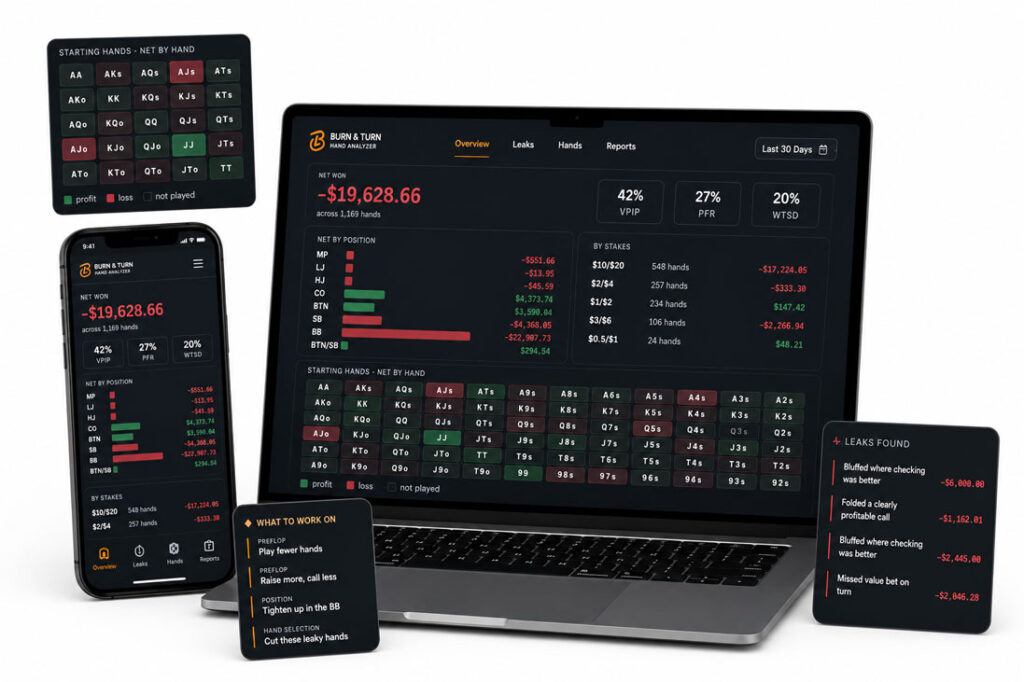
Here is a real analysis of one session, start to finish. This is exactly what you get back when you upload your own hands.

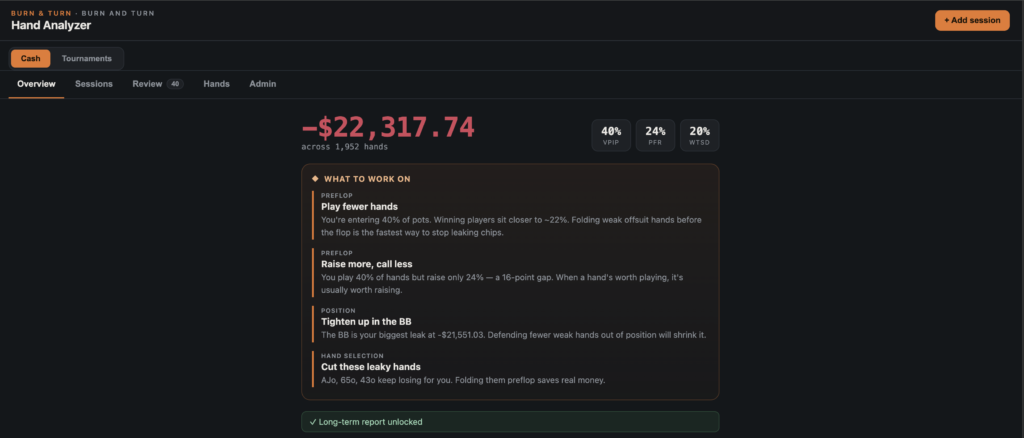
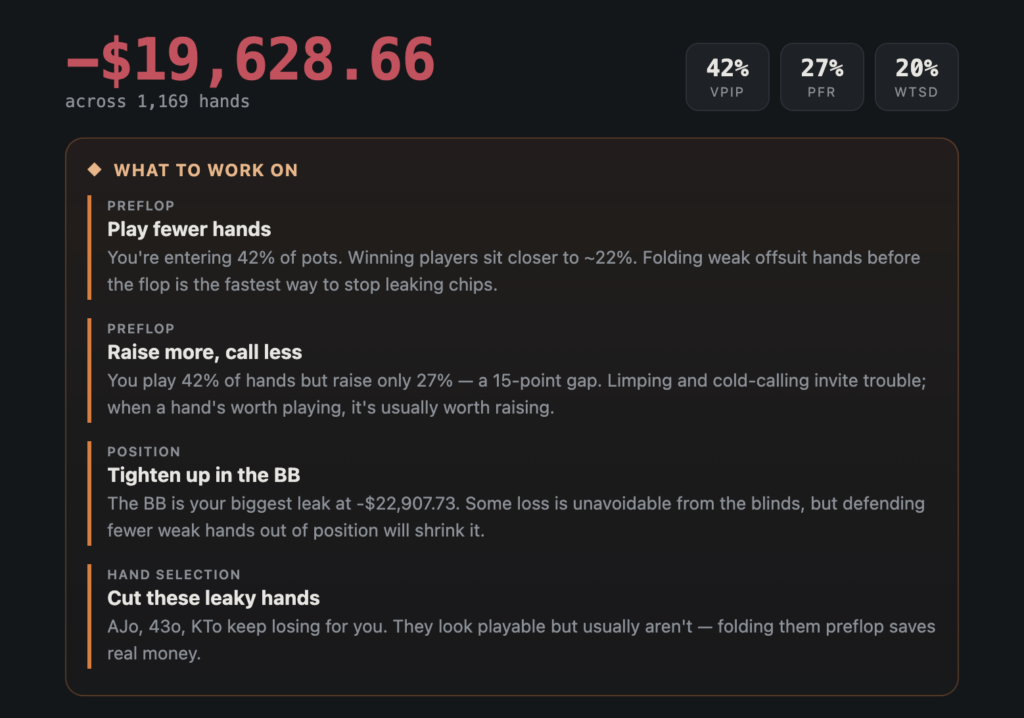
Session summary

Burn and Turn poker hand analyzer session summary showing results, VPIP and PFR, and the top leaks to work on
The session summary. Your overall result, your key stats, and a short list of what to work on first, ranked by how much each leak costs you.

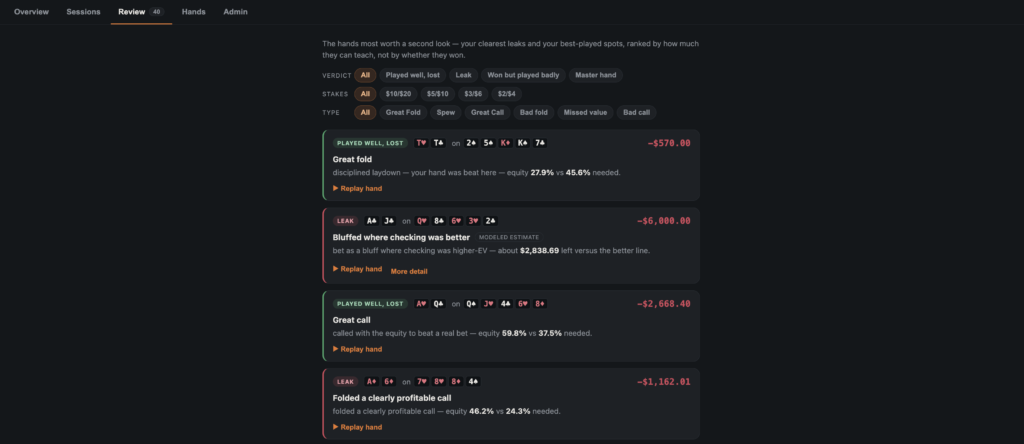
Hand review

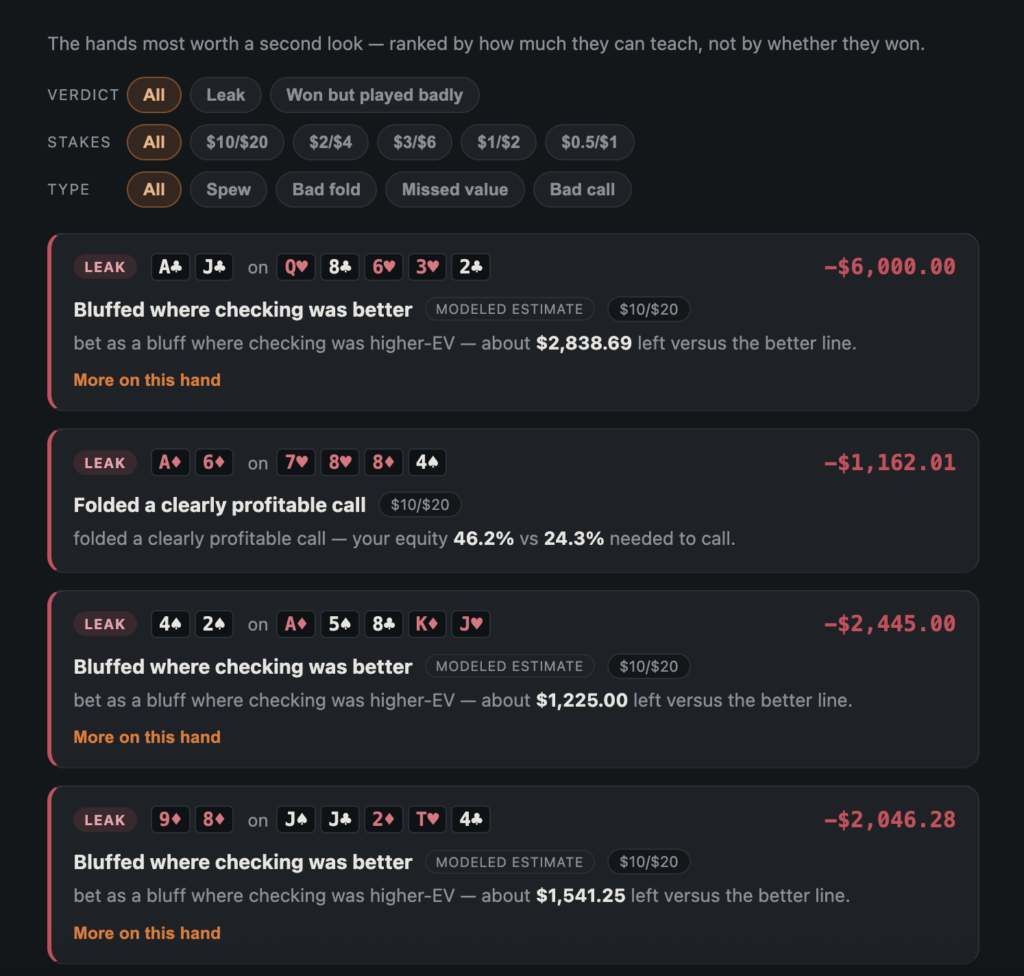
Poker hand analyzer review list showing hands tagged as leaks or well played, with equity comparisons
The hands most worth a second look. Each one is tagged as a leak or a hand you played well, with the equity math behind the verdict and a replay of the hand.

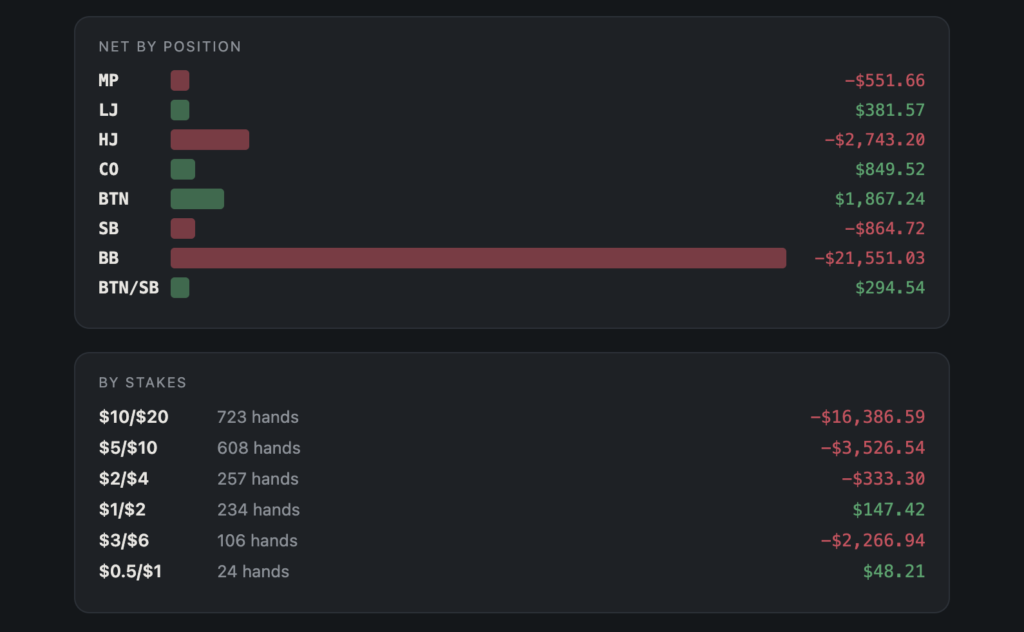
Results by position and stakes

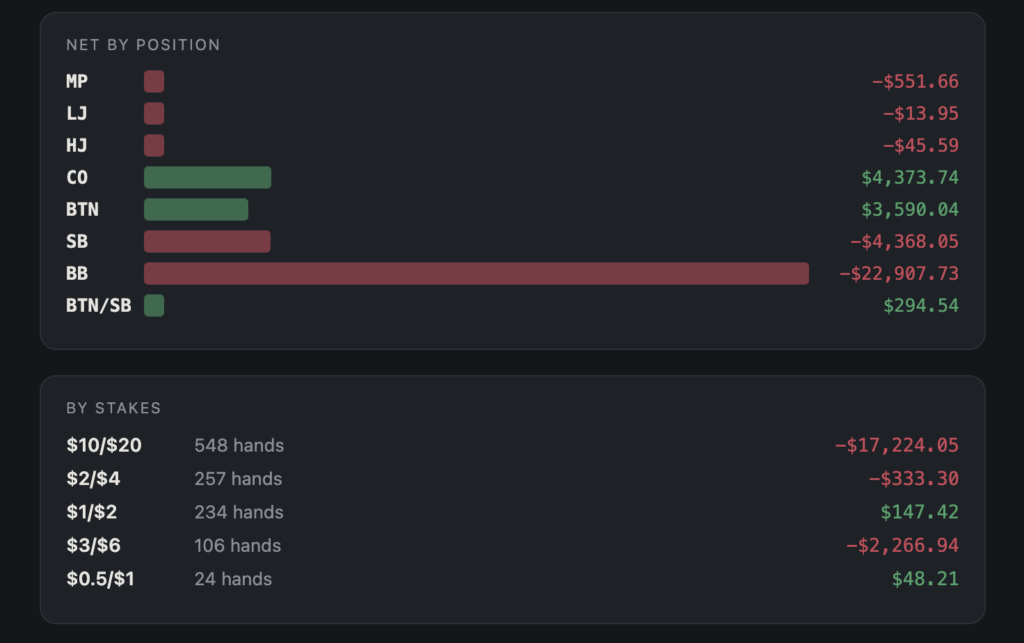
Poker hand analyzer leak profile showing results by position and by stakes
Your leak profile by seat and by stakes, so you can see exactly which positions are costing you the most.

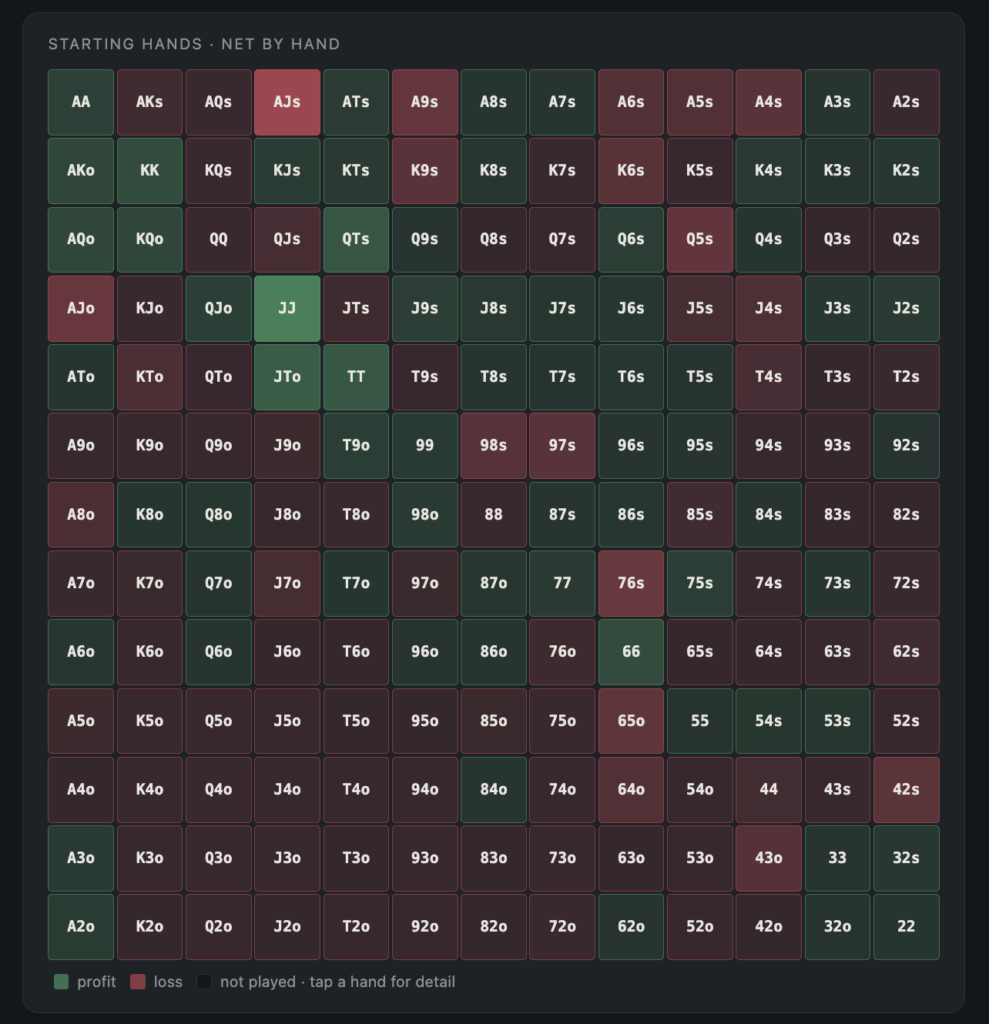
Starting hand grid

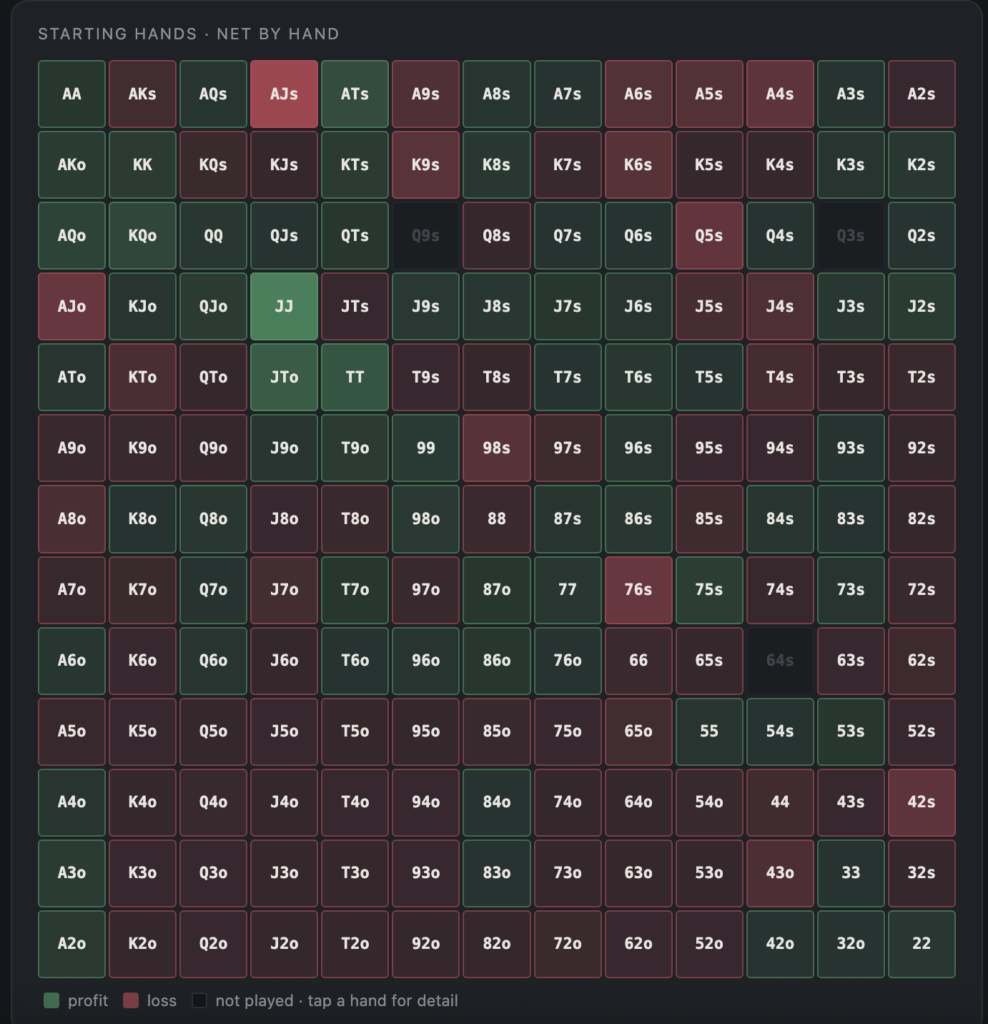
Poker hand analyzer starting hand grid colored by result for each hand class
Every starting hand class, colored by result. Tap any hand to see its detail.

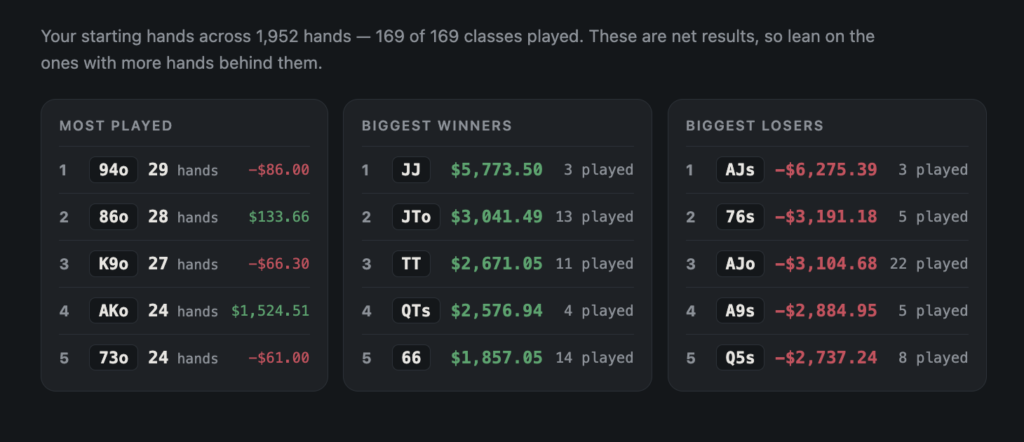
Best and worst hands

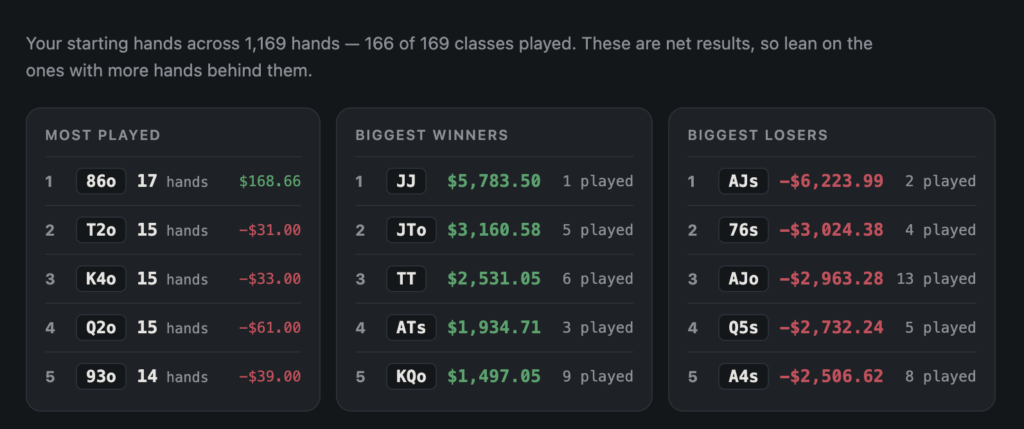
Poker hand analyzer table of most played hands, biggest winners and biggest losers
Your most played hands, your biggest winners, and your biggest losers, with the number of hands behind each one.

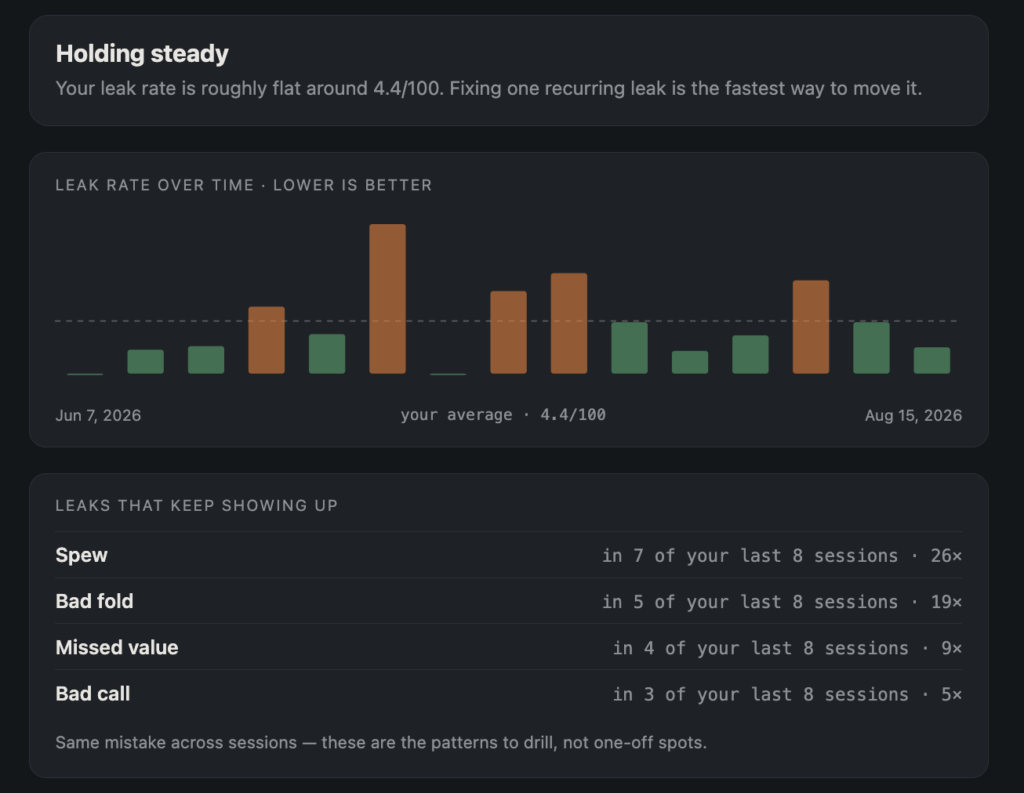
Progress over time

Poker hand analyzer progress chart showing leak rate over time and recurring leaks
Upload again next week and see whether the leak moved. Your leak rate over time, plus the mistakes that keep showing up across sessions.

FEATURES

Everything You Need to Improve Your Game

Spot Weaknesses

Immediate feedback that spots weaknesses and EV leaks

Tournament & Cash Games

Upload your cash and tournament sessions.

Instant
Feedback

See the best play and understand why instantly

Progress
Tracking

Monitor leaks, strengths, and long-term improvement

Mobile
Friendly

Train anywhere, anytime from your browser

Competitive
Edge

Study smarter and stay ahead of the field

What to Work On

Your most expensive recurring leak, surfaced first, so you know exactly what to fix next.
Hand Analysis Summary

Dive Into Each Hand

Replay any hand and see where your line and the recommended play split, and why.
ClubGG Hand Feedback

Take a Step Back

See your results across every session, by position, stakes, and starting hand.
Full Cards Analysis
Analysis Summary and Overview
Summary by Positions and Stakes
HANDS ANALYZED
0 +
PLAYERS BENEFITING
0 +
AVG ACCURACY
0 %
AVG IMPROVEMENT
+ 0 BB

What the Analyzer Evaluates

Every decision in a hand gets checked against four things.

Preflop. Whether the hand belongs in your range from that position, against that action. Opening too wide from early position and folding too tight on the button are the two most common and most expensive preflop leaks, and both show up immediately in aggregate.

Bet sizing. Whether your sizing fits the board texture, the stack-to-pot ratio, and the story you are telling. Players who use one sizing for everything are readable, and the analyzer will tell you if that is you.

Postflop line. Whether the c-bet, the check, the raise, or the fold is the highest-EV action given ranges and position. Where your line and the baseline diverge, you get the reason.

Pot odds and equity. Whether your calls were mathematically justified. This is the most mechanical part of the analysis and the one that produces the most uncomfortable results, because calls that felt fine in the moment often were not.

Across a full session the analyzer aggregates all of it into a leak profile: which positions cost you the most, which spots you misplay repeatedly, and which of your habits are actually fine.

How to Read Your Report

A few things worth knowing, because a hand analysis report can be read badly.

Start with the aggregate, not the hands. The temptation is to go straight to the big pot you lost. That pot is one data point, and it is probably the least informative thing in the file. Open the summary first and find the pattern that appears in forty hands rather than the disaster that appeared in one.

Separate mistakes from bad outcomes. These are not the same thing, and the report distinguishes them. A correct call that lost is not a leak. An incorrect call that won is. Your instinct will be to review the hands where you lost, and your instinct is wrong, because losing a pot and playing badly correlate far less than it feels like they do.

Rank leaks by cost, not by frequency. A small error you make constantly can cost more than a large error you make rarely, or much less. The report tells you which. Fix the expensive one first.

Take one leak at a time. A report showing eight things to work on is not an instruction to work on eight things. Pick the most expensive, drill it, and leave the rest until it is fixed. For structured drilling on preflop and c-bet spots, use the free poker trainer.

How to Analyze a Poker Hand Yourself

The analyzer does this automatically, but knowing the process makes the output far more useful to you. Five steps.

  1. Reconstruct the hand without the result. Write down positions, stacks, and actions. Deliberately do not think about who won. The result is the most misleading piece of information in the hand, and it will bias everything that follows.
  2. Assign ranges, starting preflop. What hands would your opponent have with that action from that position? Not what you think they had. What the whole range of hands looks like. Most bad analysis starts here, with a range narrowed to the one hand that would justify what you did.
  3. Narrow the range on each street. Every action removes hands. A check on a wet flop removes some strong hands. A large turn bet removes most weak ones. By the river the range should be small and specific.
  4. Compare your line against the alternatives. For each decision, ask what the other options were and what each would have accomplished against the range you just built. Not against their actual hand. Against the range.
  5. Find the decision, singular, that cost the most. Most hands contain exactly one real mistake. Find it and you have learned something. Rewrite the whole hand and you have learned nothing, because you cannot fix five things at once.

Doing this properly takes fifteen or twenty minutes per hand, which is why almost nobody does it for more than a handful of hands. That is the argument for the analyzer: it applies this process to every hand in the session instead of the three you remembered.

Common Hand-Analysis Mistakes

  • Reviewing only the hands you lost. The biggest one. Your worst decisions are frequently in hands you won, and those are the ones that will keep costing you, because nothing told you to look.
  • Results-oriented thinking. Judging the decision by the outcome. A call that was right at the time is right regardless of the river. If you review with the result in mind, you will systematically unlearn correct play.
  • Reviewing while tilted. A session review done twenty minutes after a bad beat is not a review, it is a grievance. Wait until the next day.
  • Only reviewing big pots. Big pots are memorable, not representative. Most players leak out of small, routine, repeated spots.
  • Analyzing in isolation. One hand tells you very little about your game. Patterns across hundreds of hands tell you a lot. This is precisely the thing humans are bad at and software is good at.
  • Reviewing and then not changing anything. Analysis without a specific change is entertainment. Every review should end with one concrete thing you are doing differently next session.

Frequently Asked Questions

Is the poker hand analyzer free?

Yes. The web app is free and there is no paid tier. You can see a sample report on this page, and a free account lets you upload your own sessions.

Do I need to download anything?

No. It runs in your browser on mobile and desktop. There is no app to install and no desktop client.

Which poker sites and apps does it support?

Hand histories from ClubGG work natively. Just export your desired hands and upload the ZIP file to the hand analyzer. No editing, format updating or extra steps. Support for other formats is expanding.

How many hands do I need to upload?

One will work and will give you a hand-level analysis. Pattern and leak detection needs volume. A few hundred hands gives you something meaningful, and a thousand or more gives you a reliable picture.

Is the analysis GTO-based?

The baseline comes from solver output, simplified for teaching rather than reproduced exactly. It will tell you what a solver plays most often and why. It is not a substitute for running your own sims in PioSOLVER, and it is not trying to be.

Can I use it for tournaments as well as cash games?

Yes, both. Tournament analysis accounts for stack depth, which changes correct play substantially. Read the two separately rather than as one combined report.

Is using a hand analyzer allowed?

Reviewing your own hand histories away from the table is standard practice and permitted essentially everywhere. Using any tool that gives advice during a live hand is a different matter and is restricted by many operators. Check your site’s rules. This is a study tool, use it between sessions.

What do you do with my hand histories?

They are used to generate your analysis and your leak profile. We look to use your leaks to have you practice with our Poker Trainer App. Your leaks will only show for your profile when using our Poker Trainer app. We do not share them. You can delete them whenever you want.

How is this different from a poker tracker?

A tracker records what happened and shows you statistics. An analyzer tells you whether each decision was correct and why. Trackers answer “what is my VPIP.” Analyzers answer “which of my decisions are costing me.”

Burn and Turn Chips

Stop Guessing About Your Own Game

Most players know roughly how they played. Almost none of them know precisely where their leaks are, and the gap between those two things is usually several big blinds per hundred hands. Upload a session and find out.

Free forever. Part of the Burn & Turn Academy, alongside the free poker trainer and the bankroll tracker.

Burn and Turn Cards