
Oftentimes, players come to us with endless stories about how the odds, the poker gods, and the world are against them. Session after session, the same story. Rarely do we hear players say, “I had a bad session… my mind just wasn’t in it.”
Most players don’t lose to cards—they lose to themselves.
Ask most poker players why they lost a session, and you’ll hear familiar answers:
- “Bad runouts.”
- “Couldn’t win an all-in.”
- “Got coolered.”
- “The table was insane.”
Sometimes those things are true.
But many losing sessions have less to do with cards and more to do with mental state.
Poker is one of the few games where you can make all the right decisions and still lose money in the short term. That creates emotional pressure that most people are not trained to handle. If you don’t manage your mind, poker becomes expensive quickly.
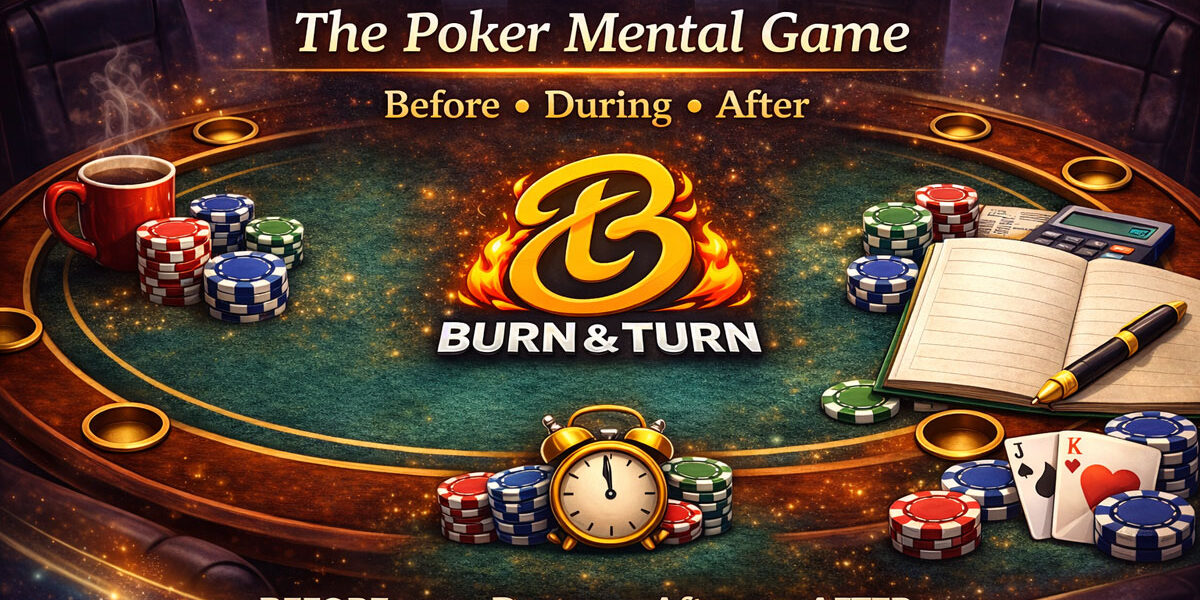
In this post, we will focus on the three stages of a strong poker mindset:
Before the game – preparing to think clearly
During the game – staying level-headed and spotting tilt early
After the game – reviewing results objectively, win or lose
If you improve your mental game, executing a strategy becomes easier.
Before the Game — Build the Right State Before the First Hand
Most players prepare for poker by doing one thing:
Opening the app or sitting down at the poker table.
That’s not preparation. Serious players understand something simple:
You don’t start the session when the cards are dealt.
You start the session with the state of mind you bring into it.
Check Your Energy Level Honestly
Before playing, ask yourself:
- Am I tired?
- Am I stressed from work?
- Am I distracted?
- Am I angry about something unrelated?
- Am I rushing because I “need” to play?
Fatigue and stress lower discipline fast. It’s an automatic bad start to any session, and it’s hard to get out of that headspace once you take a seat.
A tired player:
- Calls too much
- Misses bet sizing tells
- Gets lazy with folds
- Plays emotionally
If your energy is poor, shorten the session or skip it. Skipping bad sessions is part of winning. Having “life issues” will affect your game. Whether it’s a bad day at work, an argument with your significant other, or anything else going on in your life. It’s important to address those issues before you lift your cards. Having a level head and the ability to focus on a table will seriously improve your game.
Separate Poker Money From Life Money
Many players sit down already anxious because the money feels too important. BIG MISTAKE. Don’t ever sit on a table with money you can’t afford to lose.
That pressure creates:
- Scared folds
- Passive calls
- Revenge plays after losses
Use proper bankroll management. If losing one buy-in affects your mood heavily, the stakes are likely too high.
Confidence often comes from being properly rolled, not from motivation.
Set a Session Goal That Isn’t Money
We always tell players to focus on advancing the bases, not trying to hit a home run on every hand. Those all-in moments are the cherry on top of the session. Not the reason to play.
Bad goals:
- “I need to win $500.”
- “I’m getting unstuck today.”
- “I need to recover yesterday’s losses.”
Good goals:
- Stay patient for 2 hours
- Take notes on every player
- Fold marginal river bluff-catchers
- Quit if tilted
Make one clear decision at a time. Money goals create pressure. Process goals create performance. Since poker is a long-term game, having a process you can stick to will show results down the road.
Use a 3-Minute Pre-Game Reset
Before starting:
60 Seconds: Breathing
Slow breathing lowers emotional noise. Have a moment to yourself before the session to reset your mind.
60 Seconds: Intent
Ask yourself:
- What type of game am I entering?
- What style do I want today?
- Disciplined? Aggressive? Focused?
- Who am I playing with, and how should I adjust?
60 Seconds: Reminder
Repeat to yourself:
- I control decisions, not cards
- Variance is normal
- Patience prints money
- Simple routines outperform random moods.
We are not trying to be Tony Robbins here, but a simple moment where you say things to yourself before the game can help you focus.
Avoid Playing to Escape
Some players use poker to escape boredom, loneliness, frustration, or stress.
That usually leads to:
Too much volume, too many tables, and emotional dependency on results.
Play poker because you choose to, not because you need relief. That distinction matters more than most admit.
During the Game — Stay Level-Headed and Spot Tilt Early
Tilt doesn’t begin when you shove garbage all-in. Tilt begins much earlier. It starts when your decision-making shifts from logic to emotion.
What Tilt Really Looks Like:
Angry Tilt:
- Raising too much
- Bluffing recklessly
- Wanting revenge
Passive Tilt
- Calling because “whatever”
- Avoiding thin value bets
- Giving up too often
Desperation Tilt
- Moving up stakes
- Chasing losses
- Playing longer than planned
Entitlement Tilt
- “I deserve to win today.”
- “How can they call that?”
Tilt wears many disguises and comes up with endless excuses. Learn to be honest with yourself to improve your game.
7 Early Signs You’re Going on Tilt
Watch for these:
1. You care more about one hand than the next hand.
2. You’re replaying bad beats mentally. Over and over again.
3. You want to punish a specific player.
4. You’re checking results constantly.
5. You feel rushed.
6. You stop note-taking or observing.
7. You’re clicking buttons instead of thinking.
These are alarms. Don’t ignore them. Be aware of them and act on them. Get up from the table for a minute, take a walk, grab something to drink, a small bite to eat, breathe… whatever it is, get yourself a mental reset before you get dealt the next hand.
In-Session Tools to Stay Balanced
1. Slow the Tempo Down
When emotions rise, speed increases.
Counter it by:
- Using your full time bank when needed
- Sitting out one orbit if necessary
- Taking one deep breath before large decisions
Urgency is often emotional, not strategic.
2. Return to Ranges, Not Results
When tilted, players think:
- “He always has it.”
- “He never has it.”
- “I can’t fold again.”
Reset to:
- What hands value bet here?
- What bluffs exist?
- What would I advise a friend to do?
Strategy language cools emotional thinking.
3. Reduce Complexity
If your mind is unstable:
- Play fewer tables
- Tighten ranges slightly
- Avoid marginal hero calls
- Stop fancy bluffs
This is not a weakness. It’s damage control. Once you reset, you can expand a bit more.
4. Use a Stop-Loss Rule
A mental stop-loss is often more important than a money stop-loss.
Examples:
- Quit after 2 clear tilt mistakes
- Quit after losing composure twice
- Quit when anger is affecting decisions
Strong players know when to leave. Weak players try to “win it back.”
5. Don’t Chase Justice
Poker does not distribute fairness hand by hand. Trying to force justice after bad luck leads to disaster.
You’re not owed:
- a comeback
- a winning day
- a better river card
You are only owed future opportunities if you preserve your stack and mindset.
How to Handle a Bad Beat Properly
Immediately after a brutal hand:
Bad reaction:
- insult player
- jam next hand
- rant in chat
- spiral internally
If you ever do any of these… It’s time to leave and work on repairing your relationship with your parents.
Strong reaction:
- Sit out one hand if needed
- Deep breath
- Label it accurately: “variance”
- Return attention to next decision
Emotion wants a story. Discipline wants recovery.
How to Handle a Heater Properly
Winning sessions can damage yout mindset too.
Players on heaters often:
- loosen up too much
- force action
- assume they can’t lose
- stop thinking carefully
Stay grounded when winning. Good poker during a heater matters just as much as during a downswing. Too many times I’ve seen players 10X their buy-in to leave with nothing because they lost focus, got cocky, and forgot their goals.
After the Game — How to Review a Winning or Losing Session
Most players review sessions emotionally:
Win = “I played great.”
Lose = “I ran bad.”
That mindset blocks growth.
Separate Results From Quality.
Look back at the pre-session goals you set and ask yourself:
- Did I follow bankroll rules?
- Did I stay patient?
- Did I make avoidable emotional mistakes?
- Did I miss obvious value bets?
- Did I bluff bad candidates?
The same way that “Bad luck” can ruin your session, “Good luck” can give you false hope. If you don’t analyze your game honestly, you can walk away from a table with bad habits that will haunt you. Understand why you won or lost so you know what to work on.
Post-Session Review Template (10 Minutes)
Use this after every session.
1. What went well?
Examples:
- stayed calm after cooler
- folded tough river spot
- table selected well
2. What went poorly?
Examples:
- chased one player
- played too long tired
- forced too many bluffs
3. Hands to review later
Keep track of significant hands, hard situations, and weird spots. Take notes on these hands to better prepare for the next session. Every hand in poker is unique, but there are many patterns you can learn to better adjust your game in the moment.
4. Mental score (1–10)
Set yourself a mental score and, if you can, keep track of it. You should be using a bankroll tracker; you can get ours by signing up for our emails at the end of this blog. But when logging your sessions, leave a note that includes your mental score. Once you log a few of these, you’ll see clear patterns.
5. One lesson for next session
This simple process compounds fast. If you walk away from a session without learning anything, you had a bad session.
Reviewing a Winning Session
Be careful here. Winning creates false confidence.
Ask:
- Did I actually play well?
- Did I get lucky in key spots?
- Did I deviate and get rewarded?
- What mistakes were hidden by profit?
- Don’t let money hide leaks.
Reviewing a Losing Session
Losses create false negativity.
Ask:
- Did I make good folds?
- Did I get money in well?
- Was I unlucky or undisciplined?
- What part was controllable?
- Never use losses as proof you’re bad. Use them as data.
Track Mental Patterns Over Time
Create notes like:
- Mondays after work = impatient
- Long sessions = sloppy after hour 3
- Bad beats trigger over-bluffing
- Morning sessions = strongest focus
These patterns are valuable. Most players track money. Few track themselves.
That’s why most stay stuck.
Long-Term Mental Game Habits
Sleep Matters More Than You Think
Sleep deprivation crushes poker performance:
- worse discipline
- weaker memory
- emotional volatility
- Fitness Helps Decision-Making
Even light exercise improves patience, focus, and you’ll even play more relaxed.
Limit Session Length
Many players are profitable in the first 2 hours and bleed in hour 4+. Know your sharp window; everyone is different, just be honest with yourself.
Have a Life Outside Poker
If poker becomes your identity, every loss feels personal. That’s dangerous. It’s easy to get caught up in the game, but loosing yoursel to the cards means you are spiraling.
Final Truth: Poker Is a Mirror
Poker reveals:
- impatience
- ego
- greed
- fear
- discipline
- resilience
That’s why it’s hard. But it’s also why growth in poker often becomes growth outside poker. The strongest players aren’t emotionless; they simply recover faster, think more clearly, and respect the mental side of the game.
Poker can also be therapy in itself. Many players can spot issues in their lives by analyzing their game. Not being able to fold when you know you should may remind you of that argument with your friend that you couldn’t drop. Playing too many hands highlights impatience that may bleed into other areas of your life. If analyzed properly, poker can teach you a lot about yourself. We learn about ourselves daily with every session.
Recap:
Before the game:
Prepare your mental state. At least, know where you are to understand what can happen.
During the game:
Protect your decisions. Try to walk away from the table happy with your decisions, even if you lost.
After the game:
Review honestly. You will only lie to yourself.
Do that consistently, and your results will improve even before your strategy does.
Want to Build a Stronger Poker Mindset?
At Burn & Turn Poker Academy, we help players improve not just strategy, but discipline, review systems, bankroll habits, and emotional control.
Because the biggest edge in poker often isn’t cards.
It’s composure.